The talent and skills of some of the world’s best designers are contained in this store. Chairs, vases, platters, bowls, necklaces, shell work, baskets, silverware, jugs, figurines, teapots and coffee services are all brimming with the creativity of generations of designers and makers, and are a rich source of inspiration today.
Feature objects in the exhibition
‘Paimio’ armchair designed by Alvar Aalto

Alvar Aalto (1898-1976) was a Finnish architect and designer, known for his humanising and sensitive design ethic. This chair formed part of the furniture Aalto designed for his Paimio Tuberculosis Sanatorium, a medical facility set up for Tuberculosis (TB) sufferers, slightly north of Turku, between the two World Wars. Aalto won a competition for its design in 1928 and its construction was complete five years later. It was the first project where Aalto designed both the building and its furnishings.
This armchair complements the Tea Trolley ‘900’ also in the Museum’s collection (97/317/1). It was designed by Aalto to be used by nurses dispensing medication to patients at the Sanatorium.
Learn more about the ‘Paimio’ armchair designed by Alvar Aalto on the Powerhouse website
Volunteer Insights and Talking Points
The Paimio Chair, the best-known piece of furniture by Aalto, is named for the town in southwestern Finland for which he designed a tuberculosis Sanatorium and all its furnishings. The chair was used in the Tuberculosis patients’ lounge; the angle of the back of the armchair was intended to help sitters breathe more easily.
The Paimio Chair tested the limits of plywood manufacturing in the early 1930s. Aalto won a competition for its design in 1928 and its construction was complete five years later.
Aalto set the chair at a 110 degree angle (to support a Tuberculosis patient’s breathing); the front of the arm was curved to provide a secure support when getting up; the surface of the chair could be easily cleaned, which made it sanitary, and there were air vents in the top back of the chair to ventilate the user’s neck.
Aalto’s bentwood furniture had a great influence on the American designers Charles and Ray Eames and the Finnish-born Eero Saarinen. In 1935 the company Artek was established in Finland to mass-produce and distribute wood furniture designed by Aalto and his wife, Aino. Most of their designs remain in production today.
Question to engage general visitors
What materials do you think this chair is made of?
Question to engage younger audiences:
Would this chair be comfortable to sit it? Why?
Question to engage enthusiasts
How does this chair mimic the human body in its design?
‘Red and Blue Chair’ by Gerrit Rietveld and Cassina

Gerrit Rietveld, a member of the Dutch avant-garde group De Stijl, designed this chair in 1918. The primary colour scheme (red, yellow and blue) plus black was applied to it around 1923, in direct response to the group’s most famous theorist and practitioner, Piet Mondrian. Modernism was shaped by European artists, architects and designers who were searching for a new visual language for the 20th century after World War I. Among the most influential were members of the De Stijl group in Holland who used primary colours, geometric forms and standardised elements in their designs. They embraced mass production and believed that modern, functional and affordable houses, furnishings and objects should be available to all. The De Stijl movement, like many postwar responses to devastation, sought a greater goal for design — a utopian vision that would lift the spirit through the harmonious resolution of new forms and materials. Gerrit Rietveld’s search for a modern style resulted in a number of chair designs and architectural projects, notably the Schröder House, Utrecht, 1924. The prototype for this chair was designed and produced in unpainted beech in 1918. It was deliberately simple: the form has no complex joints, an overlapping frame and uses standard lumber sizes, which would assist in the chair’s mass production.
Learn more about the ‘Red and Blue Chair’ by Gerrit Rietveld and Cassina on the Powerhouse website
Volunteer Insights and Talking Points
Rietveld believed that there was a greater goal for the furniture designer than just physical comfort: the well-being and comfort of the spirit. Rietveld and his de Stijl colleagues—including the movement’s most famous theorist and practitioner, Piet Mondrian—sought to create a utopia based on a harmonic human-made order, which they believed could renew Europe after the devastating turmoil of World War I. New forms, in their view, were essential to this rebuilding.
The chair is a reproduction made by Cassina in Italy in 1984 of the famous Rietveld chair. Rietveld was a member of the Dutch avant-garde group De Stijl. Rietveld was one of the most influential members of the group who used primary colours, geometric forms and standardised elements in their designs.
Rietveld manipulated rectilinear volumes and examined the interaction of vertical and horizontal planes in much the same way as he did in his architecture. Although the chair was originally designed in 1918, its color scheme of primary colours (red, yellow, blue) plus black—so closely associated with the Dutch de Stijl art and architecture movement—was applied around 1923.
Rietveld hoped that much of his furniture would eventually be mass-produced rather than handcrafted, Rietveld aimed for simplicity in construction. The pieces of wood that compose the Red and Blue Chair are in the standard lumber sizes readily available at the time.
Question to engage general visitors:
Do you think this chair would be comfortable? What elements would make it comfortable? (eg; slant of chair seat)
Question to engage younger visitors:
How many pieces of wood can you count that are vertical ? How many horizontal?
Question to engage enthusiasts:
Let’s examine the simplicity of the design, and the interaction between vertical and horizontal. In essence it is a stripping of traditional chairs of its volume and emphasised functionality. How would people have responded to this design in 1923?
‘DCW’ dining chair by Charles and Ray Eames

You may not realise it, but chances are you’ve seen or sat in an Eames moulded plywood chair. They seem to be everywhere, even though most people can rarely put a name to the familiar form.
This original DCW (dining chair wood) was designed by leading furniture designers Charles and Ray Eames at the end of World War II. The chair is made from moulded plywood and was manufactured in America by Herman Miller in about 1946. The Eames moulded plywood chairs are considered among the most iconic chairs of the 20th century.
During World War II Charles Eames experimented with a revolutionary new process for moulding plywood and developed sophisticated equipment capable of mass producing it. The standard metal splints medics had used to brace wounded servicemen were actually causing further injury, so Charles and Ray Eames designed and supplied 150,000 plywood leg splints for the United States Navy. Drawing on their wartime experience the Eames produced the DCW (dining chair wood) and the LCW (lounge chair wood) in 1945. Capable of efficient mass-production, the chairs were comprised of five separate pieces of formed plywood, which could be quickly assembled on the production line using rubber shock mount connectors to give flexibility and reliance. The range was extended over the next year by versions of the chair with metal rod legs, a lounge chair and a series of tables.
Learn more about the ‘DCW’ dining chair by Charles and Ray Eames on the Powerhouse website
Volunteer Insights and Talking Points
During World War II Charles Eames developed a revolutionary new process for moulding plywood, The Eames developed sophisticated equipment capable of mass producing formed plywood. They used this technology to supply 5,000 plywood leg splints to the US Navy.
Charles and Ray Eames are regarded as America’s leading post-war furniture designers. They were the first to apply the process of moulding plywood to industrial design.
In a 1972 interview Eames said of his early plywood work: ‘The idea was to do a piece of furniture that would be simple and yet comfortable. It would be a chair on which mass production would not have anything but a positive influence: it would have in its appearance the essence of the method that produced it.’
The Eames ‘DCW’ was not only a successful expression of its technology; it, and the metal leg chairs, also became symbols of the era in which they were produced – a time of experiment, changing attitudes and lifestyles.
Question to engage general visitors:
This chair is quite beautiful (in my opinion) in its design, what elements make it beautiful?
Can you see how this chair was assembled in mass-production?
Question to engage younger audiences:
Even though this chair was mass-produced, do you think it’s comfortable and sturdy?
What elements make it comfortable and sturdy?
Question to engage enthusiasts:
We know that this chair was mass-produced using a new process for moulding plywood. This chair comprises of five separate pieces of formed plywood which was quickly assembled on the production line using rubber shock mount connectors to give flexibility and reliance. Can we identify the five separate pieces of formed plywood just by looking at it? Talk about the ingenious behind the moulding process/mass-production.
Daum vase decorated with deer motifs

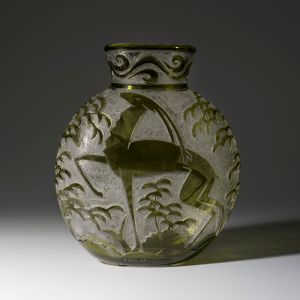
This art deco vase was made by French glass manufacturer Daum in about 1925. Cameo glass and an acid-etch techniques were used to create the stylised scene of a male and a female deer surrounded by foliage, with narrow bands and a scroll pattern encircling the neck above.
French glass manufacturer Daum excelled in producing glassware. Daum designers favouring geometric forms as well as thicker and more transparent glass. Daum glass was shown at the 1925 Exposition Internationale des Arts Décoratifs et Industries Modernes in Paris, from which came the term art deco, a fashionable international style of the inter-war period (1918–39). One of the Daum vases on display was a deer vase almost identical to this example, except it was smaller and the figures were rendered more naturalistically.
This vase is larger, heavier and has bolder motifs. In an unmistakably art deco design, the deer is stylised to appear more dignified and poised. This design was most likely produced not long after the Paris display, and was issued in at least two colourways: smoky brown and olive green. These colourways, in addition to blues, topaz and amber, took inspiration from cubist art of the time. The contrast of the smooth, olive green motifs against a clear textured background was created using the cameo or cased glass technique, where a piece of glass is overlayed with a thin piece of glass in a different colour. The outer layer is then partially removed to reveal the design. The olive-green outer layer of this vase has been cut and acid-etched, giving a textured, frosted appearance to the clear background.
Learn more about the Daum vase decorated with deer motifs on the Powerhouse website
Volunteer Insights and Talking Points
Daum’s Art Deco glass was shown at the 1925 Exposition Internationale des Arts Décoratifs et Industries Modernes in Paris. One of their vases on display was a deer vase almost identical to this example.
This vase was made by the French glass manufacturer Daum (est.1878) around 1925. Daum were masters of French decorative glass. The vase is an example of Art Deco, the fashionable international style of the inter-war period (1918-39) which was often inspired by Cubism and African art.
Daum excelled in the production of Art Deco glassware and its designers favoured geometric forms as well as thicker and more transparent glass which contrasted with slender shapes and flowing lines of Art Nouveau glassware so popular at the turn of the century.
Vases, bowls and lamp shades no longer relied on the glassblowing technique but were cast and decorated with cut and acid-etched stylised patterns, as illustrated by this vase. The new manager Paul Daum was chemist by training and experimented with the use of hydrofluoric acid to vary surface textures of the glass.
Question to engage general visitors:
What materials do you think where used to make this vase?
Question to engage younger audiences:
What animals / images can you see on this vase?
Question to engage enthusiasts:
What aspects of the vase contribute to the Art Deco movement?
Moon Beams and Coral: Purukapali’s Grief

These ceramic figures are based on traditional Tiwi figures of carved wood. They tell the story of Purukapali, who walked into the sea carrying the spirit of baby son Jinani. They were designed and made by Mark Puautjimi of Tiwi Design on Bathurst Island, in Australia’s Northern Territory.
Although made from buff clay they are based on traditional Tiwi figures of carved wood.
Learn more about the Moon Beams and Coral: Purukapali’s Grief on the Powerhouse website
Volunteer Insights and Talking Points
This work combines two key Tiwi figures: the first man Purukupali (Purukuparrli) and his wife Bima (Wayayi). Purukapali’s brother Tapara (Japara) seduced Bima, who left her baby Jinani under a tree. The baby died when the hot sun shifted and shone on him. In his grief Purukupali walked into the sea with his son and disappeared forever. Tapara, with his face slashed by a stick, became the moon and Bima became a curlew (bird). According to Tiwi legend, the baby Jinani’s death was the first death, and it was followed by the first Pukumani (burial) ceremony. This story, together with some of the decorative motifs on the figures, is also represented on Tiwi textiles in the Museum’s collection. This design of this work tells the story of Purukapali, walking into the water (represented by the blue and green colours) carrying the spirit of his baby son Jinani.
These ceramic figures are major examples of a new form of ceramic production at Tiwi Pottery on Bathurst Island. They are based on traditional figures carved in wood.
The Tiwi craft workshops were first set up as Tiwi Pottery by NSW potter Ivan McMeekin at Bagot Reserve, Darwin in 1968. At that stage pottery was made in a functional stoneware aesthetic espoused by McMeekin and English potter Michael Cardew. This aesthetic was centred on decoration from ash and flame in the kiln, with some underglaze line drawing in natural colours and sgraffito.
In early 1999 Steve Davies decided to abandon vessel-making and concentrate instead on encouraging the potters to investigate making figures in clay, based on those traditionally made in wood as part of Tiwi ceremonies. They researched documentation of old carved figures and over a six-month period about 4 artists developed about 20 ceramic works. This direction was very successful and the works were keenly sought after by major museums.
Question to engage general visitors:
What do you think this sculpture represents?
Question to engage younger audiences:
What do you think this sculpture is made off?
Question to engage enthusiasts:
Why do you think this new direction in ceramic works was so sort after?